Historic Sites
Qutub Minar
The 73-metre red sandstone tower begun by Qutub-ud-din Aibak in 1193, and India's tallest minaret, twenty kilometres north of Cyber City.
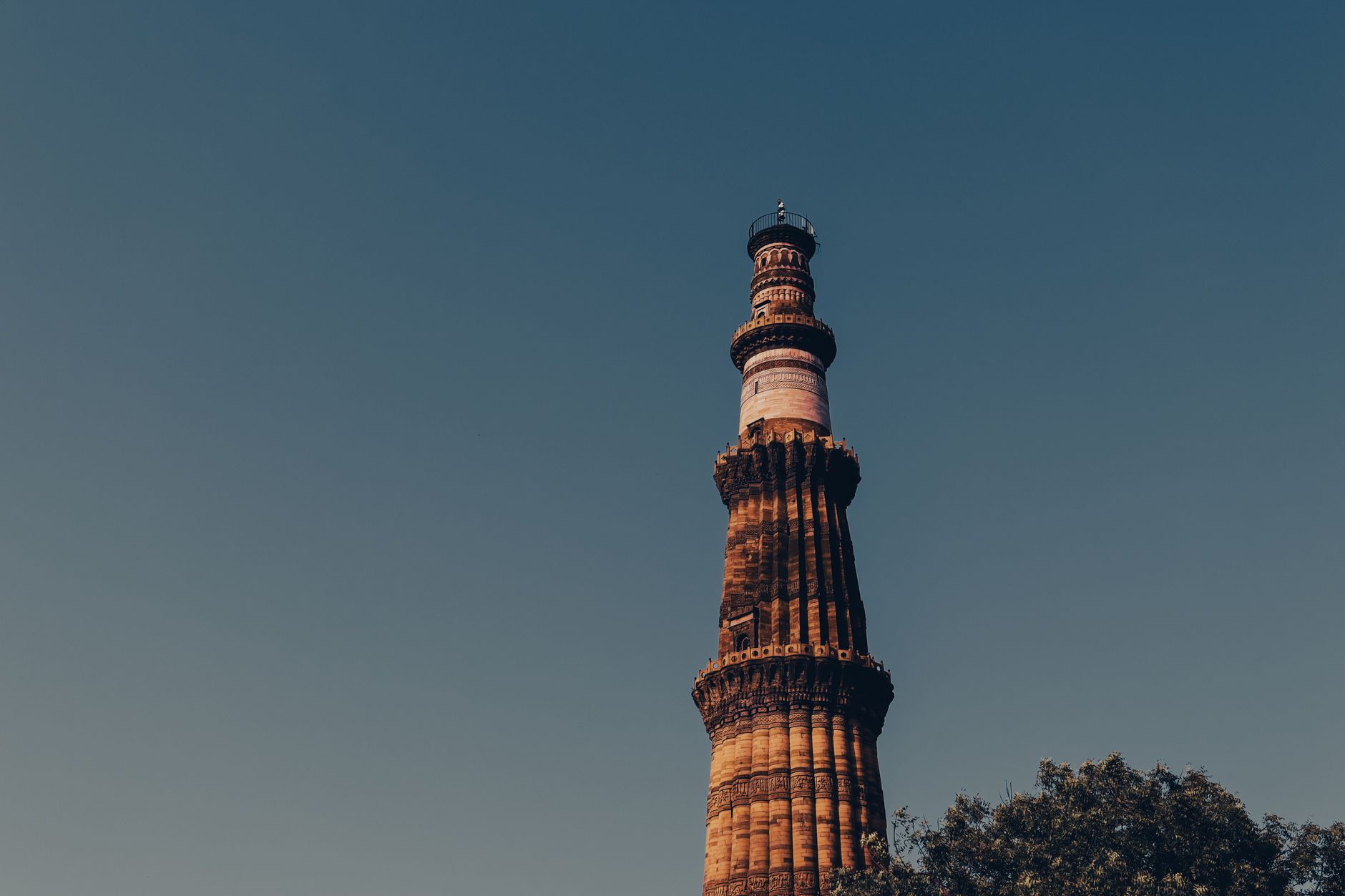
Qutub Minar is a UNESCO World Heritage site and the closest major monument to Gurugram — twenty kilometres north across the Delhi border. Construction began in 1193 to celebrate the Delhi Sultanate's arrival and continued under three rulers until 1368; the fluted red sandstone tapers from 15 metres wide at the base to 2.7 metres at the top, with bands of Quranic calligraphy at each of its five storeys. It is the tallest brick minaret in the world.
The complex holds more than the tower. The Quwwat-ul-Islam mosque next to it was built with pillars from twenty-seven Hindu and Jain temples that stood on the site, and the salvaged carvings are visible in the arcades. In the courtyard stands the sixth-century Iron Pillar of Delhi, famous for not rusting despite 1,600 years exposed to the weather. Around the tower are the Alai Darwaza gateway, the incomplete Alai Minar (intended to be twice the height of Qutub before its patron died), and the tomb of Iltutmish.
Come first thing at 7am — the light on the sandstone is best and coach tours arrive by 10am. The site is walkable in about ninety minutes at a normal pace. From Gurugram, the Qutub Minar metro station is one stop past Chhatarpur on the Yellow Line and a fifteen-minute walk from the ticket gate. Buy tickets online on the ASI portal to skip the counter queue. The tower interior has been closed to climbers since 1981; you view from below only. Combine with lunch in Mehrauli village nearby.
Past the bag scan the path runs onto open lawn, and the sequence that works is anticlockwise. Start at the Alai Darwaza, Alauddin Khalji's gateway of 1311 on the south side — its horseshoe arches and marble banding carry India's first true dome, and five minutes there frames everything that follows. Then the Quwwat-ul-Islam courtyard and the Iron Pillar, fenced since 1997 after decades of visitors wore the shaft smooth trying to link their arms behind it. The tower base comes next; the full taper only fits in a photograph from the southeast lawn, about forty paces back. Most groups leave at that point, which is why the tomb of Iltutmish in the northwest corner is usually empty — its interior carving is the finest stonework on the site and deserves ten minutes. Finish at the Alai Minar stump and at Smith's Folly, the cupola removed from the tower in 1848, sitting on the grass.
From Gurugram the metro is the honest answer. Board the Yellow Line at HUDA City Centre and stay on through IFFCO Chowk, MG Road, Sikanderpur, Guru Dronacharya, Arjan Garh, Ghitorni, Sultanpur and Chhatarpur; Qutub Minar is the tenth stop, about 30-35 minutes, and the fare is around ₹40 each way. From the station it is roughly 1.5 km south, fifteen minutes on foot along Anuvrat Marg, or ₹30-50 in an e-rickshaw from the rank outside. Driving, take Mehrauli-Gurgaon Road from Sikanderpur past Ghitorni and Chhatarpur to Andheria Mor, then turn onto Anuvrat Marg — twenty kilometres, forty minutes before 9am and well over an hour if you leave after 5pm, because Andheria Mor jams in both directions. A cab from Cyber City runs ₹400-600 one way. There is a paid car park beside the complex, but it fills by 11am on Sundays; take the metro and skip the problem.
Tickets are ₹40 for Indian, SAARC and BIMSTEC visitors and ₹600 for other foreign nationals, with under-15s free — two adults and two children pay ₹80 in total. Online booking on asi.payumoney.com produces a QR code you scan at the gate, worth doing at weekends when the counter queue runs fifteen to twenty minutes. Still photography is free, a video camera costs ₹25 extra, drones are banned outright, and tripods need written permission you will not obtain on the day. Licensed guides wait at the gate and start around ₹500 an hour, more than ten times the ticket; agree the figure before you walk in, and ignore the unlicensed touts who work the walk up from the station. There is no café inside and nothing sold beyond drinking-water points, so buy a ₹20 bottle before the gate. Two adults travelling from Gurugram by metro spend roughly ₹240 on the whole outing.
The first hour, 7am to 8am, is the visit worth planning around: the gate is quiet, the sandstone reads orange rather than pink, and you can stand alone at the Iron Pillar fence. Coach groups land between 10am and 1pm, school parties are heaviest on weekday mornings from September to February, and Sundays and public holidays put real crowds on the lawns between 11am and 4pm. Seasonally, mid-October to mid-March is the window — 10-25°C, clear light, dry grass. April to June hits 40-45°C with no shade anywhere inside the complex. The monsoon from July to September greens the lawns and deepens the colour of the stone, but there is nowhere to shelter from an afternoon downpour. From November to early January smog often flattens the tower into grey haze by mid-morning, so on those days the 7am opening is not a preference but the only good hour.
Families do well here: the lawns absorb small children, under-15s pay nothing, and ninety minutes is about the limit of anyone's attention span. Tell children in advance that the staircase has been shut since 1981, or the disappointment lands hard at the base. Wheelchair users can reach the tower and circle most of the main lawn on flat paved paths from the ticket gate, but the mosque plinth, the Iron Pillar courtyard and Iltutmish's tomb are all up steps with no ramp, so roughly a third of the site is out of reach. Teenagers give it forty-five minutes and are ready to move on to Mehrauli. A rainy afternoon is the wrong call entirely — this is an outdoor site with no covered gallery, no museum room and no café to wait it out in. And do not attempt it in a one-hour gap from Gurugram: the round trip alone is two hours before you buy a ticket.
Fold in Mehrauli Archaeological Park, whose entrance is a ten-minute walk down Anuvrat Marg and which costs nothing to enter: Jamali Kamali's mosque and tomb, the stepped Rajon ki Baoli, Balban's tomb and Quli Khan's tomb rebuilt by Thomas Metcalfe all sit inside it, spread across unsignposted scrub that few visitors bother with — go in daylight with a map on your phone. Adham Khan's tomb, the octagonal Bhool Bhulaiyan beside the Mehrauli bus terminus, is fifteen minutes further on. For lunch, Olive Bar & Kitchen and Qla on Kalka Das Marg are five minutes away and both run past ₹2,500 for two. Two honest warnings: there is no working sound-and-light show, so there is no evening visit to plan for, and nobody has climbed this tower in over forty years — anyone arriving in hope of the view from the top has come for something the site cannot give.
Hours & entry
Not free
Mon-Sun 7:00-17:00
What to see
{'what': 'The Iron Pillar of Delhi', 'where': 'Central courtyard of the Quwwat-ul-Islam mosque'}
{'what': 'Reused Hindu and Jain temple pillars in the arcade', 'where': 'West colonnade of the mosque'}
{'what': 'The incomplete Alai Minar stump', 'where': 'North side of the complex, beyond the mosque'}
Tips from the ground
Buy online tickets on asi.payumoney.com — skips the entire queue.
Arrive at 7am opening for the best light and no coach groups.
Combine with lunch at Olive or Qla in Mehrauli, five minutes away.
Good to know
Questions, answered
How much does entry cost?
₹40 for Indian visitors, ₹600 for foreign nationals. Children under 15 free. The ₹40 tier also covers SAARC and BIMSTEC nationals, so two adults and two children from Gurugram pay ₹80 in all. Book on asi.payumoney.com and show the QR code at the gate. Still photography is free, a video camera adds ₹25, and drones are banned. Licensed guides quote from about ₹500 an hour — more than ten times the ticket — so agree the price before you start walking.
Are there free days?
Yes — World Heritage Day (18 April) is free entry for everyone. That also makes it the busiest day of the year, with the lawns filling from about 9am and a slow-moving crowd at the gate even though nobody is paying. Under-15s enter free every day, so families only ever buy adult tickets. There are no free evening hours, no free first Sunday and no concession for students or seniors. For a quiet visit, pay the ₹40 on an ordinary weekday morning instead.
How long does a visit take?
About ninety minutes to two hours for the full complex. Budget roughly twenty minutes for the mosque courtyard and the Iron Pillar, fifteen for Iltutmish's tomb, ten each for the Alai Darwaza and the Alai Minar stump, and the rest for photographs from the southeast lawn. Because the tower interior has been closed since 1981 there is no staircase queue to add unpredictable time. Add thirty to forty minutes if you continue into Mehrauli Archaeological Park, and two hours for the return trip from Gurugram by metro.
When is it closed?
Open every day of the year; last entry is 5pm. There is no weekly closing day and no seasonal shutdown, but the gates open at 7am and guards begin clearing the lawns around 4:45pm in winter, so arriving after 4pm gives you a rushed visit rather than a full one. There is no evening opening and no sound-and-light show running, so anyone planning a night visit should think again. On 18 April the site is open as usual and free to all.
Do I need to book?
Not required, but online tickets skip the queue at the counter. Buy on asi.payumoney.com the same morning — tickets are valid for the day with no timed entry slot, so there is nothing to plan around. The counter queue is negligible at 7am and runs fifteen to twenty minutes by mid-morning on Sundays and public holidays. Keep the QR code on your phone and take a screenshot in case the signal drops at the gate. Under-15s need no ticket at all.
Nearest metro?
Qutub Minar station on the Yellow Line, 15 min walk to the entrance. From HUDA City Centre in Gurugram it is the tenth stop, via IFFCO Chowk, MG Road, Sikanderpur, Guru Dronacharya, Arjan Garh, Ghitorni, Sultanpur and Chhatarpur — about 30-35 minutes for roughly ₹40 each way. The walk is 1.5 km south along Anuvrat Marg on pavement most of the way; e-rickshaws at the station gate charge ₹30-50 if the heat is against you. Ignore the guides who approach along that stretch.
Doing good is the business: every booking through Stay Gurugram funds one verified tonne of carbon removal — same room, same price, no markup.
Start your search